Improved Solar Shade (ISS) with Enhanced Durability & Performance
INCA was invited by the U.S. Marine Corps to demonstrate the INCA Solar Off-Loading Technology at ExFOB 4, Marine Corps Base TwentyNine Palms, California. These extreme conditions would provide essential testing of INCA Solar Off Loading Technology (SOLT), a surface treatment that essentially nullifies the heat generated by solar exposure. Reduced solar heating enhances shade; reducing the required energy offset and extending the duty cycle of the fabric and HVAC equipment. The monitoring and analysis was performed over six days under the auspices of the U.S. Marine Corps and the U.S. Navy through Carderock Naval Laboratory.
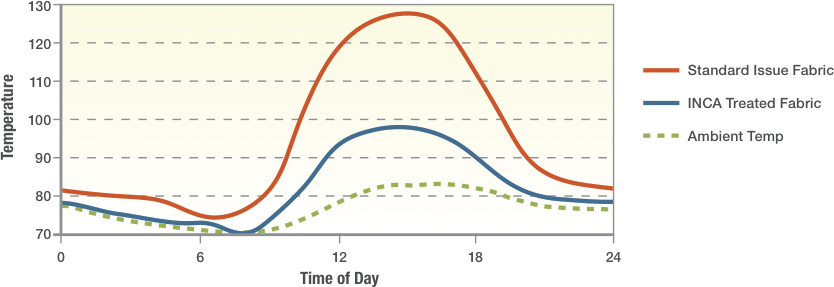
Our demonstration consisted of two Utilis TM18 tents, one SOLT treated and the other untreated standard. The following chart illustrates the net energy effect during one typical hour of monitored run time.

The chart clearly illustrates the radically different power consumption of two environmental control units (ECU) each supplying a single fabric structure (tent), one coated with INCA Solar Off Load Technology (SOLT), the other un-coated standard issue fabric.
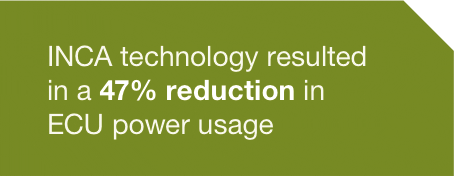
The INCA SOLT enhanced fabric (blue line in chart) required 47% less energy to maintain a set temperature of 78° F, as compared to the standard issue military specification fabric (red line in chart). Compressor cycling and compressor run times were reduced significantly; resulting in reduced fuel and maintenance requirements.
INCA was invited to participate in the Net Zero Continuum at Holloman, AFB, NM. We supplied a treated Utilis TM60 fly for evaluation. Both flies were constructed from Bondcote L70606, vinyl coated weft mesh. One was treated on one side with INCA CTC100 SOLT TFTM in 686 Tan.
The Product Performance:

- At surface temperatures around 140° F, INCA SOLT yields a 28° reduction in thermal pass through Vs. 44103D standard fabric. Reductions of thermal pass through can result in a 47% savings of off-set energy.
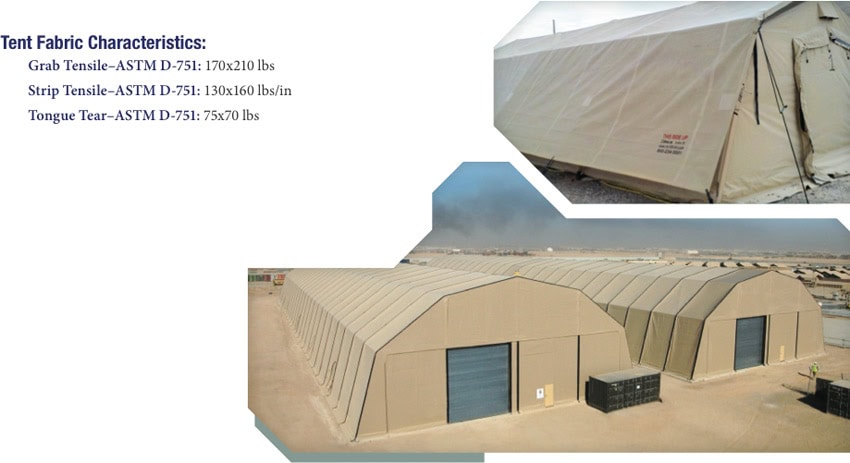
- Physical characteristics are similar to the current ‘state of the art’ mil spec fabric, not requiring any changes to current deployment practices.
- A result of the reduced temperature loads, the service life of the fabric can be extended.
- INCA SOLT has no weight penalty to the finished goods.
INCA was invited to participate in the Net Zero Continuum at Holloman, AFB, NM. We supplied a treated Utilis TM60 fly for evaluation. Both flies were constructed from Bondcote L70606, vinyl coated weft mesh. One was treated on one side with INCA CTC100 SOLT TFTM in 686 Tan.